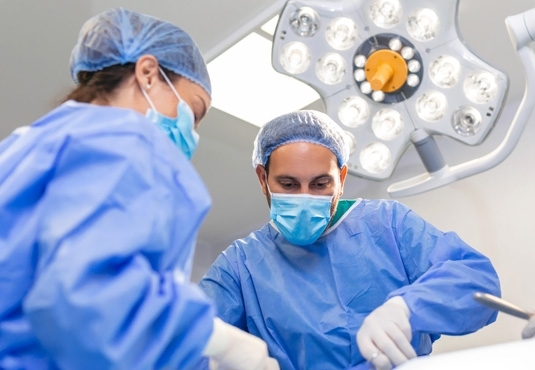
Penile curvature surgery is a reconstructive surgical procedure performed to correct congenital penile curvature or acquired penile curvature, most commonly caused by Peyronie's disease.
The primary goal of surgery is to straighten the penis as much as possible during erection, thereby improving sexual function, facilitating comfortable intercourse, and enhancing the patient's overall quality of life. Not every penile curvature requires surgical treatment. However, surgery may be recommended when the curvature is severe enough to interfere with sexual intercourse or significantly affect physical or psychological well-being.
This procedure is most commonly performed for patients with congenital penile curvature or stable Peyronie's disease. During surgical planning, the surgeon carefully evaluates the degree and direction of the curvature, penile length, erectile function, and the patient's expectations to determine the most appropriate surgical technique for each individual.
Penile curvature surgery is considered for patients whose curvature negatively affects sexual function, causes discomfort during intercourse, or significantly impacts quality of life. Mild penile curvature often does not require treatment if it does not interfere with sexual activity.
Surgical correction is generally recommended for men experiencing difficulty with sexual intercourse due to the curvature, penile pain associated with deformity, or significant cosmetic concerns causing psychological distress.
Patients with a penile curvature greater than approximately 30 degrees during erection, progressive deformity, or stable Peyronie's disease are commonly considered suitable candidates for surgery. Erectile function is also an important factor when selecting the most appropriate surgical approach.
Not every case of penile curvature requires surgical intervention. Mild curvature that does not interfere with sexual intercourse may simply be monitored without treatment.
Surgery is generally reserved for patients whose curvature causes functional impairment, prevents satisfactory sexual intercourse, or significantly reduces quality of life.
For patients with Peyronie's disease, international guidelines recommend surgery only after the disease has reached the stable phase, meaning the curvature has remained unchanged for at least 3–6 months, penile pain has largely resolved, and the total duration of the disease is typically 12 months or longer.
Additional indications for surgery include:
Penile curvature surgery is a reconstructive procedure individually planned according to the underlying cause of the curvature, its severity, penile length, and the patient's erectile function.
According to current international urological guidelines, surgery is recommended only after Peyronie's disease has entered its stable phase, when the curvature has remained unchanged for at least 3–6 months and the overall disease duration has generally exceeded 12 months. This approach minimizes the likelihood of further disease progression after surgery.
The procedure is usually performed under general or spinal anesthesia. At the beginning of the operation, the surgeon creates an artificial erection by injecting saline into the erectile tissue. This allows precise assessment of the degree and direction of the curvature, as well as identification of additional deformities such as hourglass narrowing or penile indentation. This step is critical in selecting the most appropriate corrective technique.
Once the surgical plan has been finalized, a small incision is made to expose the tunica albuginea, the fibrous layer surrounding the erectile bodies. Depending on the patient's anatomy and the characteristics of the deformity, the surgeon performs the most suitable corrective procedure.
The primary objective is not only to straighten the penis but also to preserve erectile function and restore comfortable, satisfying sexual activity whenever possible.
At the end of the operation, meticulous bleeding control is performed, and a protective dressing is applied when necessary. Most patients can be discharged on the same day or after an overnight hospital stay, depending on the surgical technique used and their overall condition. Complete recovery generally takes several weeks, although the exact healing period varies according to the procedure performed.
There is no single surgical technique for correcting penile curvature. According to current international urological guidelines, the most commonly recommended procedures include penile plication, plaque incision or excision with grafting, and penile prosthesis implantation. The choice of procedure depends on several factors, including the severity and type of curvature, penile length, erectile function, and the patient's individual expectations.
Penile plication is one of the most frequently performed procedures for correcting penile curvature. During this operation, permanent or long-lasting sutures are placed on the convex (longer) side of the penis to equalize the length of both sides, resulting in a straighter erection. Because the fibrous plaque is not directly manipulated, the procedure is less invasive and generally requires a shorter operative time.
Penile plication is particularly recommended for patients who have:
The primary disadvantage of this technique is that shortening the longer side of the penis may result in a slight perceived decrease in penile length, although patient satisfaction remains high in appropriately selected cases.
Patients with severe penile curvature, deformities greater than 60 degrees, significant penile shortening, or complex deformities such as an hourglass narrowing are often better candidates for plaque incision or excision with grafting.
During this procedure, the fibrous plaque responsible for the curvature is either partially incised (relaxed) or completely removed (excised). The resulting defect in the tunica albuginea is then reconstructed using a biological or synthetic graft to restore the normal shape of the penis.
The main advantage of grafting procedures is that they aim to correct the curvature without significantly shortening penile length. However, because this is a more technically demanding reconstructive surgery, the procedure generally takes longer and requires meticulous preservation of the penile nerves and blood vessels. For this reason, grafting procedures should ideally be performed by surgeons with specialized expertise in reconstructive urology.
If penile curvature is accompanied by erectile dysfunction that does not respond to medication, implantation of a penile prosthesis may be the most appropriate treatment option.
After the prosthesis has been inserted, any remaining curvature can often be corrected during the same operation using additional techniques such as manual modeling, penile plication, or grafting, depending on the degree of residual deformity.
Current international guidelines generally recommend the use of inflatable penile prostheses, as they provide the most natural erectile function and high patient satisfaction.
This combined approach restores erectile function while simultaneously correcting penile curvature. Long-term studies have demonstrated particularly high satisfaction rates among patients with advanced Peyronie's disease associated with severe erectile dysfunction.
The duration of penile curvature surgery varies depending on the surgical technique used and the complexity of the deformity.
Most procedures are completed within 1 to 3 hours. Simple plication procedures generally require less operative time, whereas graft reconstruction or surgery combined with penile prosthesis implantation may take considerably longer.
Following surgery, many patients are discharged on the same day or after an overnight hospital stay. The length of hospitalization depends on the patient's overall health, the complexity of the procedure, and the surgeon's postoperative protocol.
Recovery after penile curvature surgery varies depending on the surgical technique performed and the patient's general health. However, most patients are able to resume normal daily activities within a few weeks. Careful adherence to the surgeon's postoperative instructions is essential for optimal healing and long-term surgical success.
Following penile curvature surgery, adequate healing time is necessary before resuming sexual activity.
In most cases, patients are advised to avoid sexual intercourse and masturbation for approximately 4–8 weeks, although the exact recovery period depends on the surgical technique used and individual healing.
Returning to sexual activity too early may place excessive tension on the surgical repair, potentially leading to bleeding, wound complications, or recurrence of the curvature. Clearance to resume sexual activity should always be given by the operating surgeon during a follow-up examination.
When performed by an experienced reconstructive urologist, penile curvature surgery has a high success rate. Nevertheless, as with any surgical procedure, certain risks and complications may occur, although they are relatively uncommon.
Potential risks include:
Before surgery, the patient's degree of curvature, erectile function, penile anatomy, and treatment expectations are carefully evaluated. Selecting the most appropriate surgical technique helps maximize success while minimizing the risk of complications.
Following successful surgical correction, most patients maintain a straight penis for many years.
However, particularly in patients with Peyronie's disease, recurrent curvature may occasionally develop because of the underlying biological progression of the disease. The likelihood of recurrence depends on factors such as disease stage, surgical technique, tissue characteristics, and individual healing responses.
Regular postoperative follow-up and adherence to the surgeon's recommendations help optimize long-term outcomes. If recurrent curvature develops, additional evaluation can determine whether further treatment is necessary.
The cost of penile curvature surgery in 2026 depends on several factors, including the surgical technique performed, the severity of the curvature, the hospital where the operation is carried out, the materials used during surgery, and the surgeon's level of expertise.
Procedures involving penile plication, grafting, or penile prosthesis implantation differ in complexity and therefore may vary significantly in cost.
For ethical and legal reasons, it is not appropriate to provide exact surgical fees online. The most accurate cost estimate can only be determined after a comprehensive consultation with a urologist, including a physical examination, diagnostic evaluation, and development of an individualized treatment plan. This approach ensures both appropriate treatment selection and accurate pricing based on the patient's specific medical needs.
 Prof. Dr. Levent PeşkircioğluUrology & Andrology


My husband underwent prostate surgery on Thursday. We would like to sincerely thank Dr. Levent and Dr. Alev, the anesthesiologist, as well as all the nurses at the hospital, especially Nur{...}
09 October 2025For one year, I had been searching for a good doctor. During this period, I took my son to two different public hospitals, but we did not get any positive results. While doing research on{...}
07 June 2025We visited many supposedly top doctors in both private and university hospitals for my husband’s urinary tract obstruction. Unfortunately, the procedures we underwent were short-term and l{...}
07 April 2024